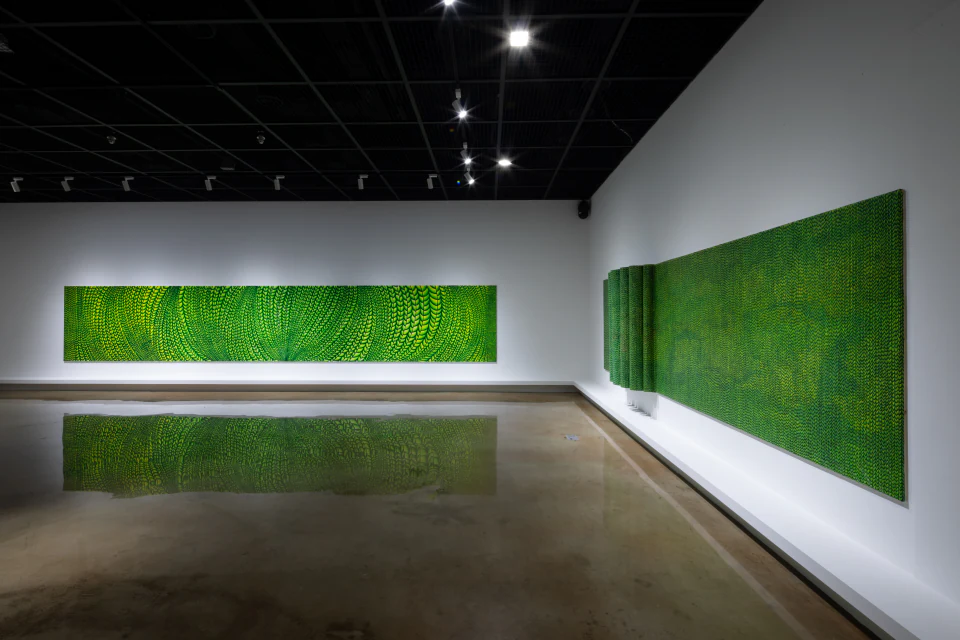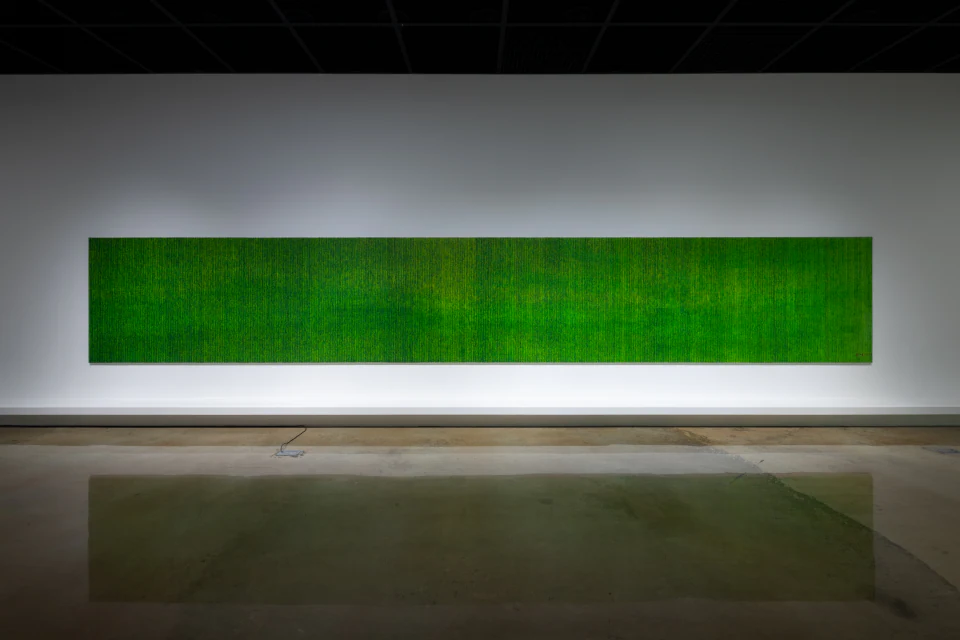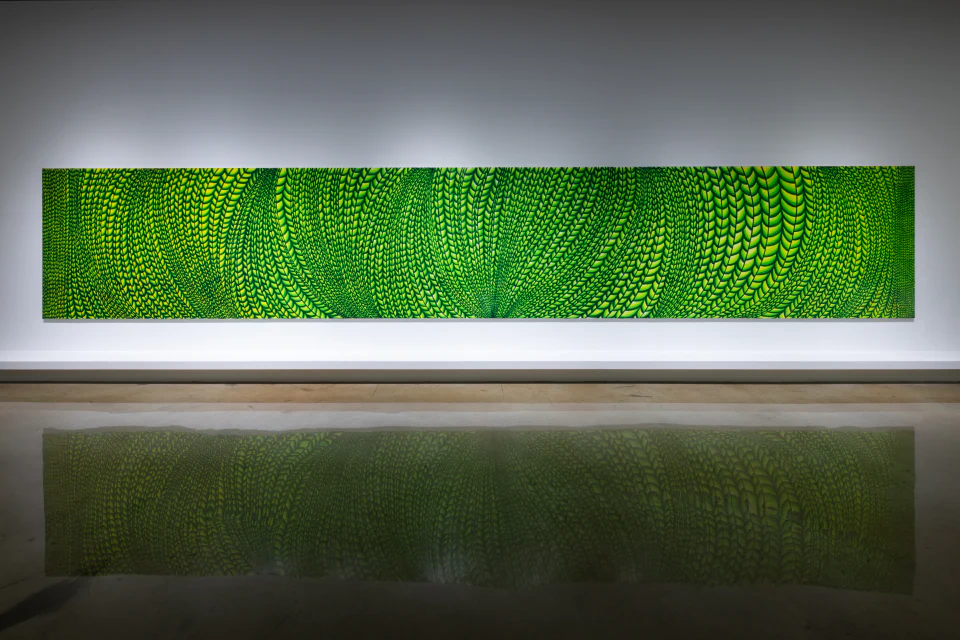
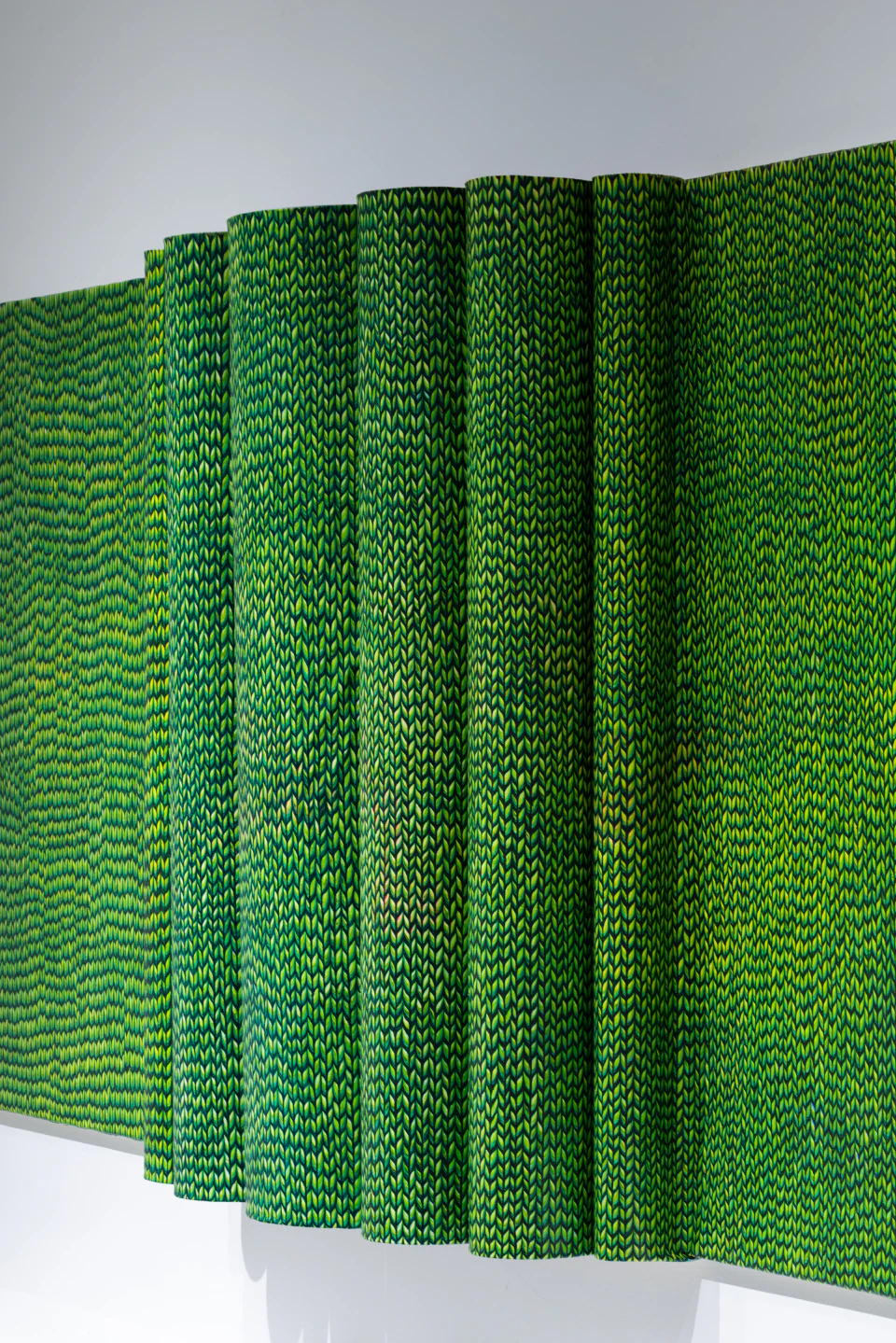
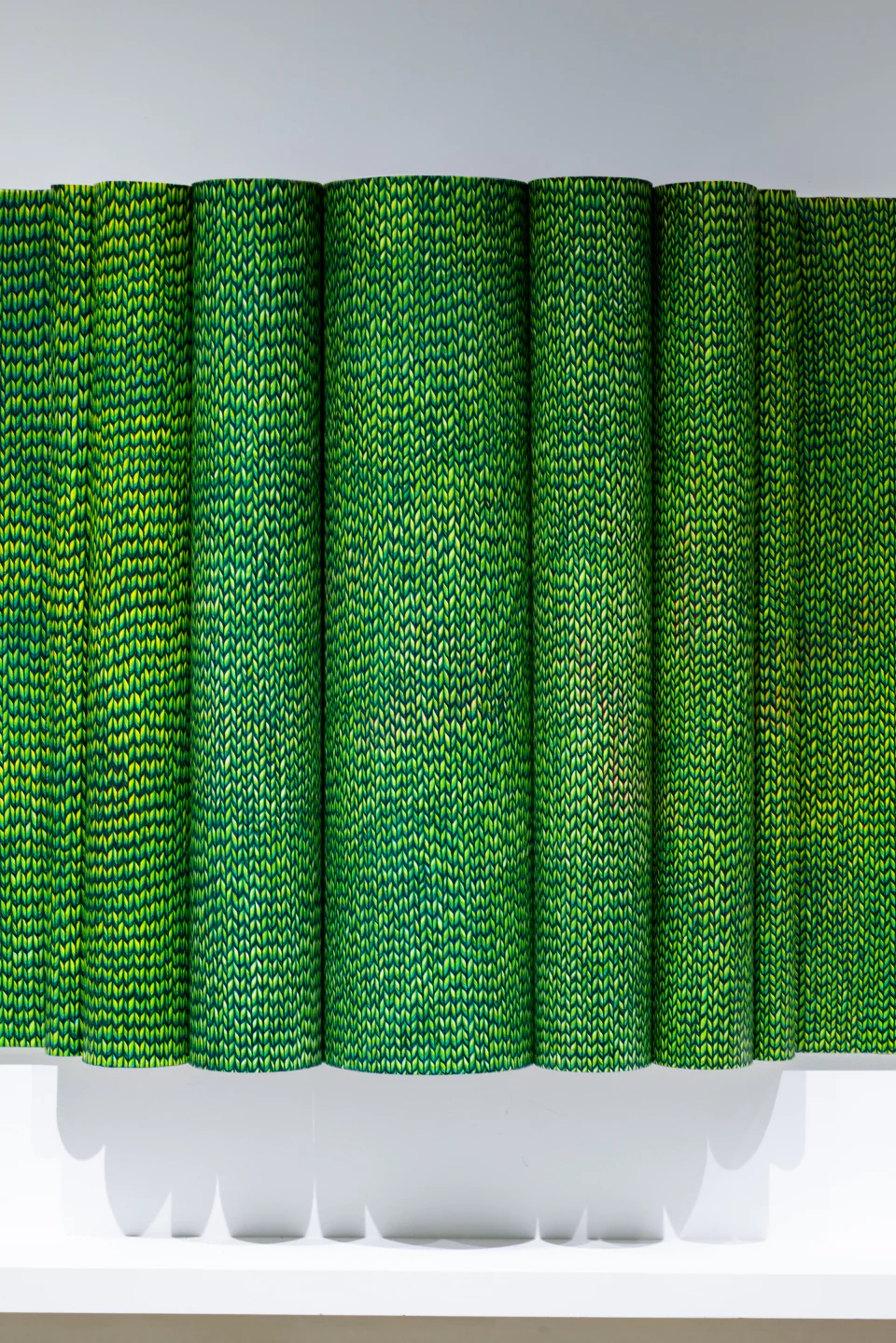
162.2 × 900.0 cm

JEONG WOOKYUNG · PAINTER
회화는 평면을 넘어 접히고 휘어지며, 몸으로 경험하는 공간으로 확장된다. 반복되는 한 올의 붓질은 시간을 축적하며 작품과 관람자, 그 둘을 둘러싼 세계를 연결한다.
정우경은 반복되는 붓질로 뜨개의 조직을 회화로 구현하며, 사랑·기억·시간의 감각을 대형 회화와 입체적 캔버스, 설치적 경험으로 확장한다. 한 올이 다른 한 올과 연결되어 하나의 직물을 이루듯, 개인의 기억은 공동체의 시간으로 이어지고 사랑은 인간과 사회, 자연과 생명을 연결하는 근원적 에너지가 된다. 그의 반복은 사라지는 시간을 붙잡는 행위이자, 분리된 존재들을 다시 관계 속에 엮어내는 지속적인 회화적 실천이다.
SELECTED WORKS
선의 반복은 손의 움직임을 통해 축적되는 시간을 기록한다. 뜨개의 리듬 안에서 인물과 자연, 대지의 이미지가 떠오르며 개인의 기억은 공동체의 삶으로 이어진다. 캔버스의 확장은 사랑과 생명의 에너지가 화면을 넘어 공간 속에서 지속되는 방식이다.


ABOUT THE ARTIST
정우경은 대전·세종·서울을 중심으로 활동하며 시간, 기억, 관계와 생명의 에너지를 회화로 탐구해 왔다. 어린 시절 어머니가 손수 떠준 옷에 담긴 돌봄과 기다림의 기억에서 출발해 ‘뜨개는 사랑이다’라는 예술적 명제를 세웠다.
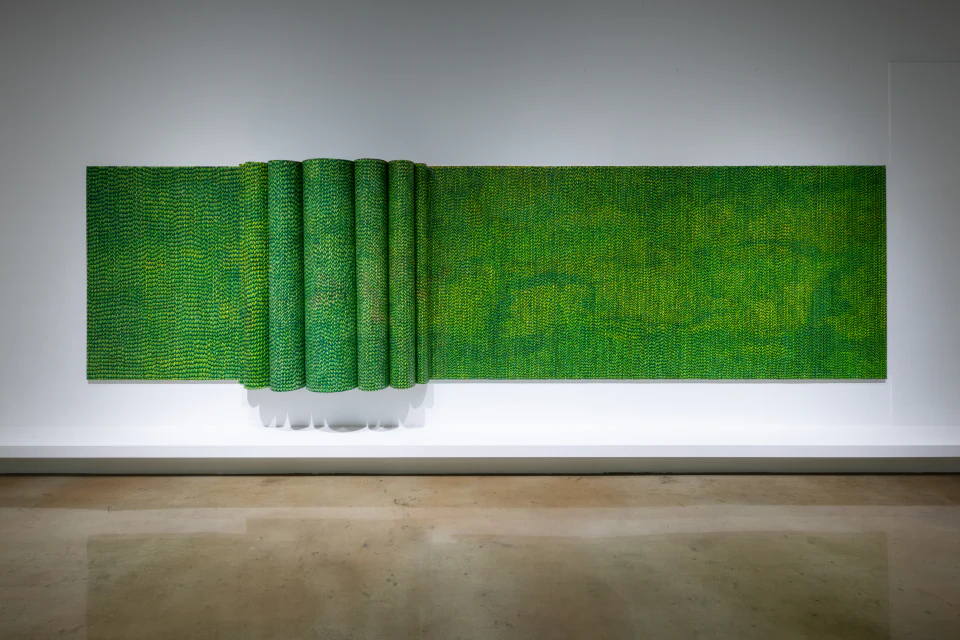
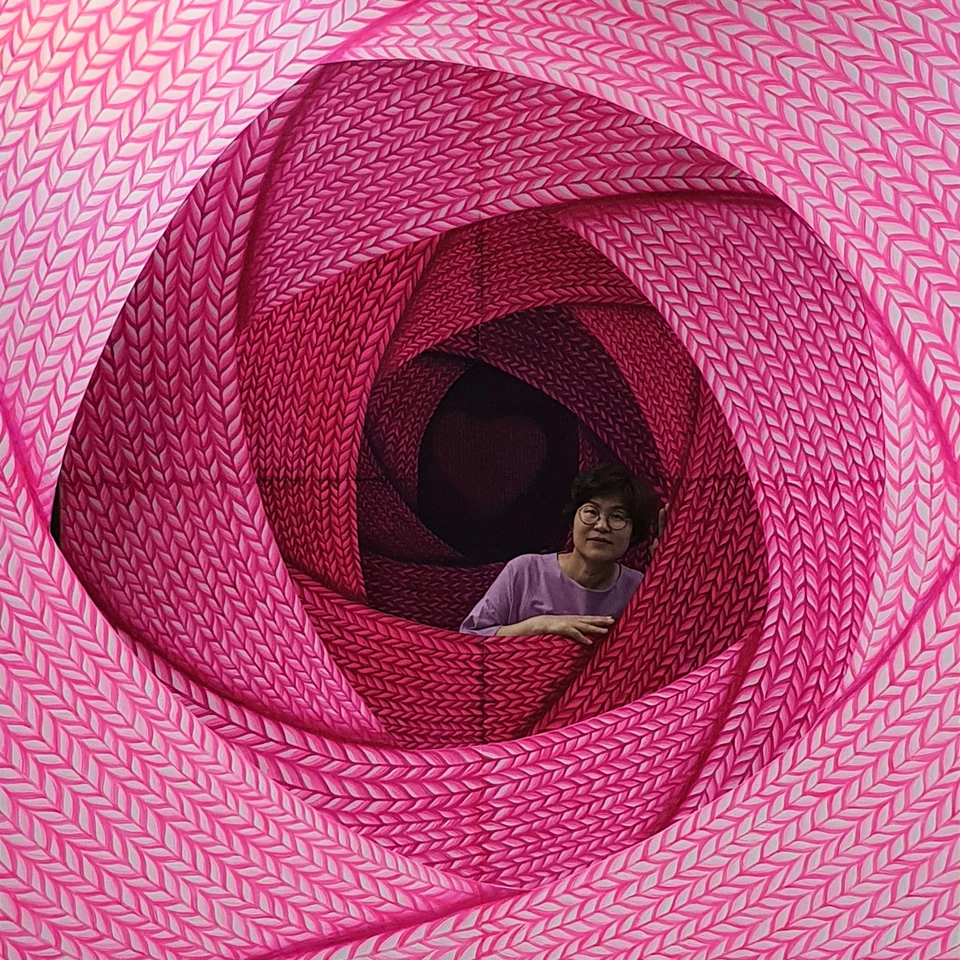
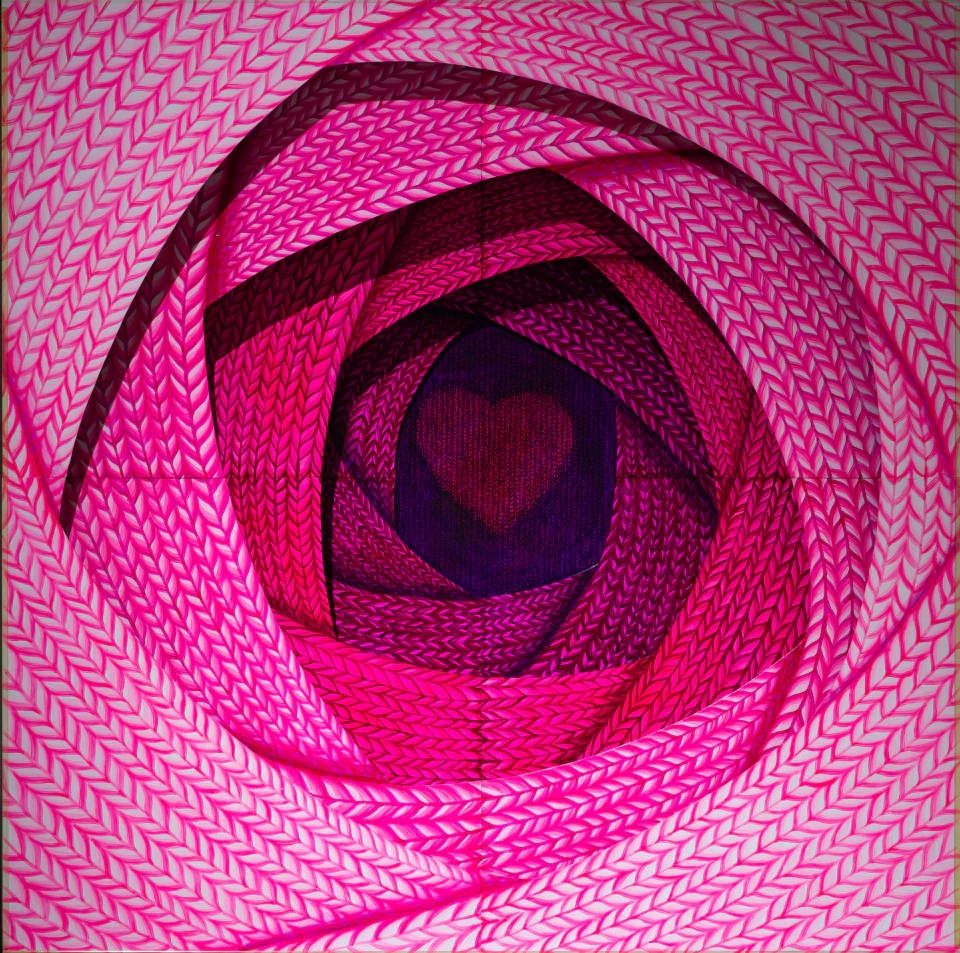
실제 실을 사용하지 않고 수천, 수만 번의 섬세한 붓질로 뜨개 조직과 같은 표면을 만드는 독자적인 ‘뜨개 회화’를 구축했다. 반복은 시간의 축적이자 관계의 은유이며, 최근에는 캔버스를 구부리고 중첩하거나 부풀려 평면을 실제 공간과 관람자의 신체 경험으로 확장하는 ‘회화의 멀티플렉스’를 전개하고 있다.
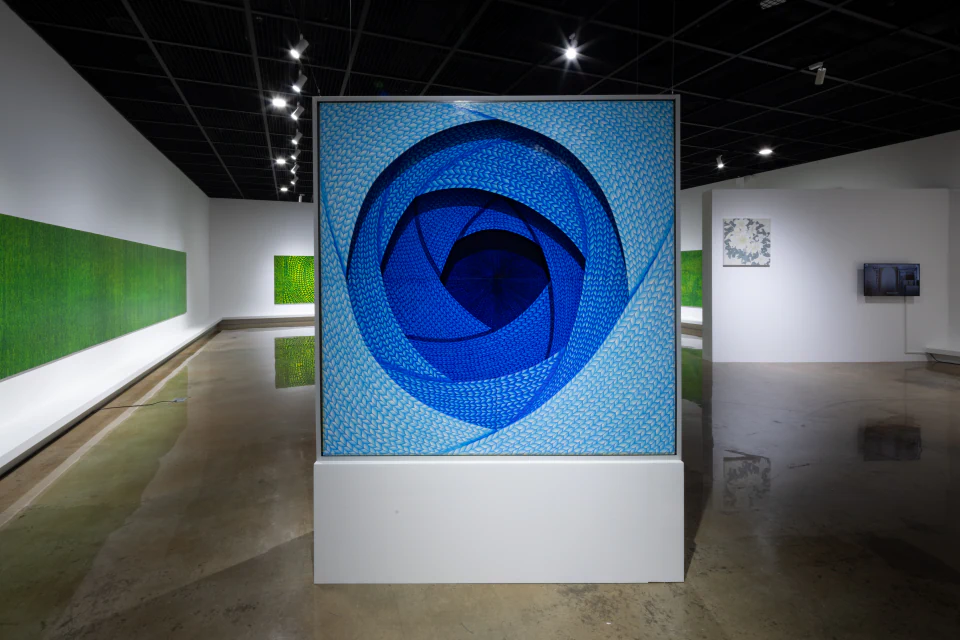
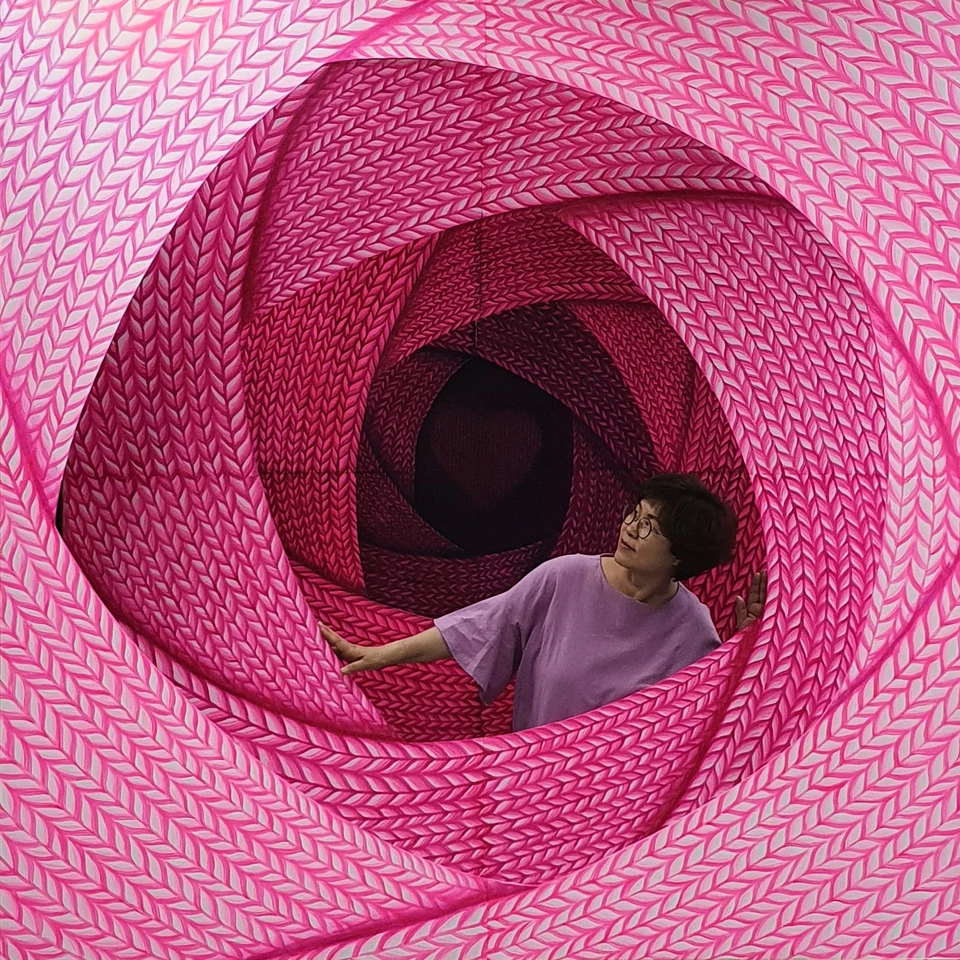
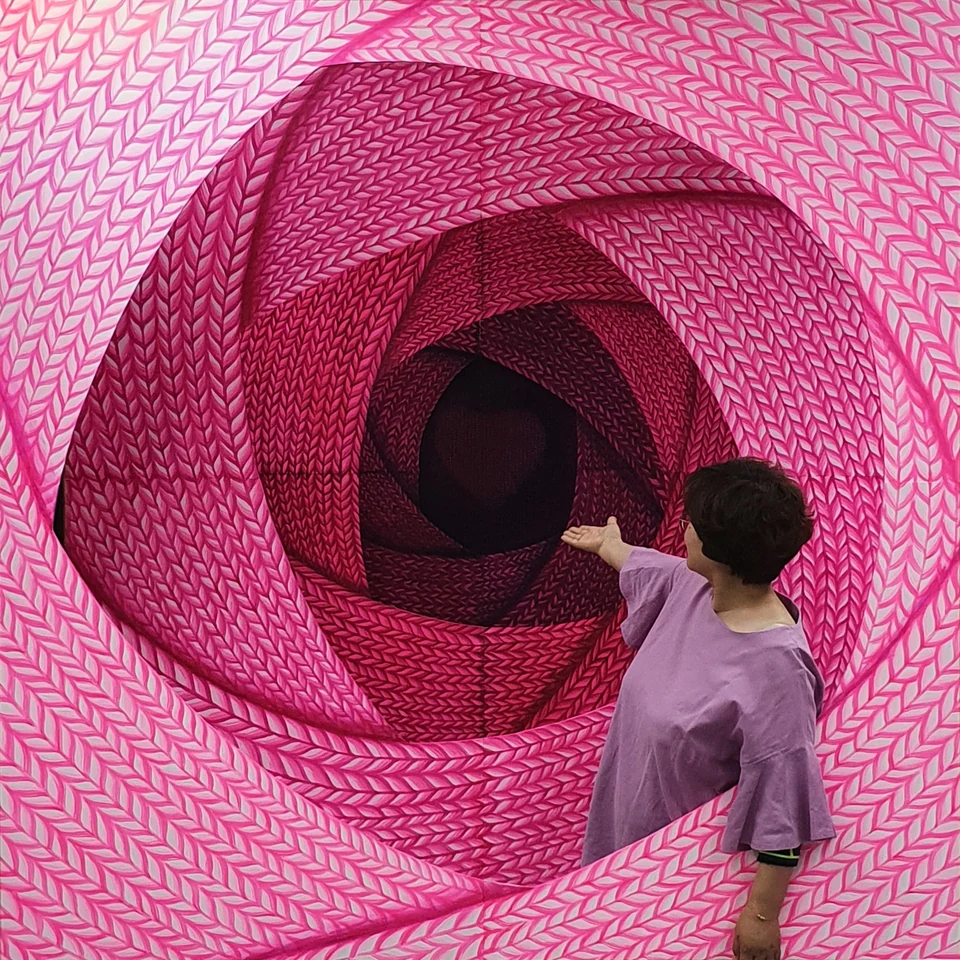
이 회화는 화면의 가장자리에서 끝나지 않는다. 한 코가 다른 코와 연결되어 하나의 직물을 이루듯, 반복되는 붓질은 작품과 사람, 사람과 공간 사이로 관계를 이어간다. 관람자는 작품 사이를 걷고 위치를 바꾸면서 선의 리듬과 표면의 촉각, 오랜 시간 축적된 에너지를 몸으로 경험한다. 정우경에게 공간은 회화에 덧붙인 장식이 아니라, ‘연결’이라는 뜨개의 원리가 화면 밖의 실제 경험으로 확장된 결과이다.
EXPANDED CANVAS
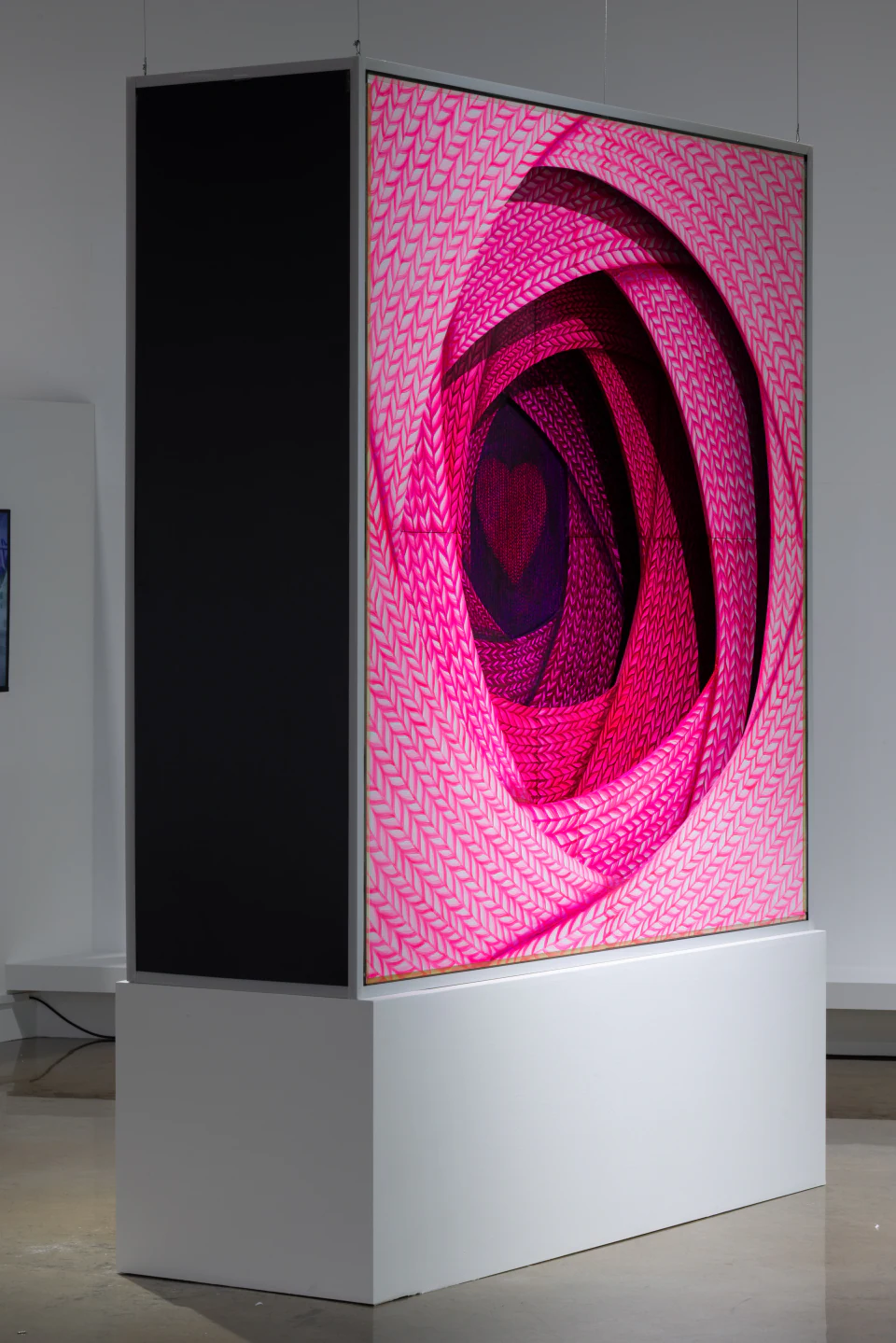
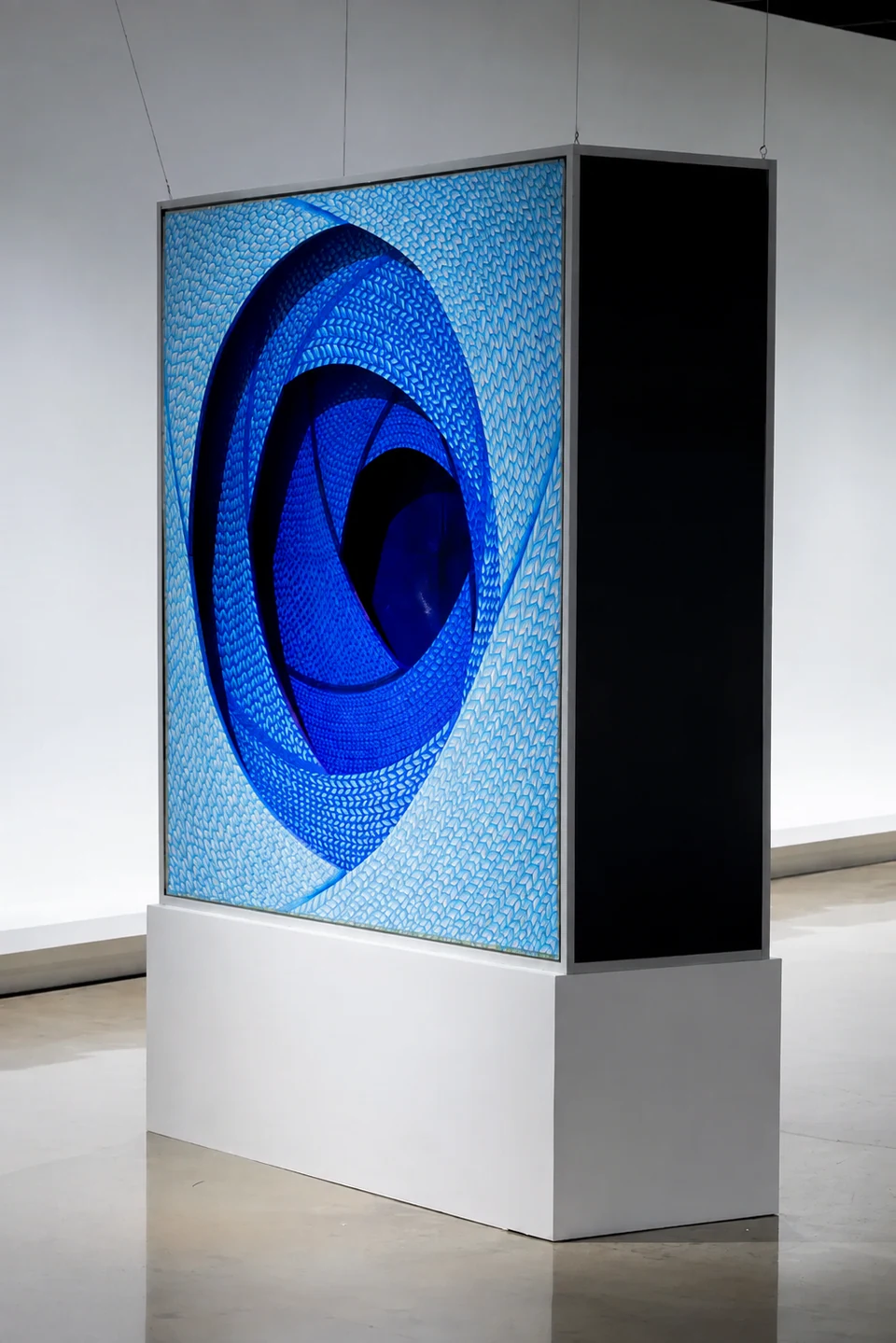
회화는 더 이상 벽에 머무르지 않는다. 접히고 솟아오르며 내부를 품은 구조는 캔버스를 하나의 물리적 존재로 변화시킨다. 관람자가 위치를 바꾸고 작품 주위를 움직일 때, 보는 행위는 색과 리듬, 깊이와 공간을 몸으로 만나는 경험이 된다.
SURFACE & DETAIL
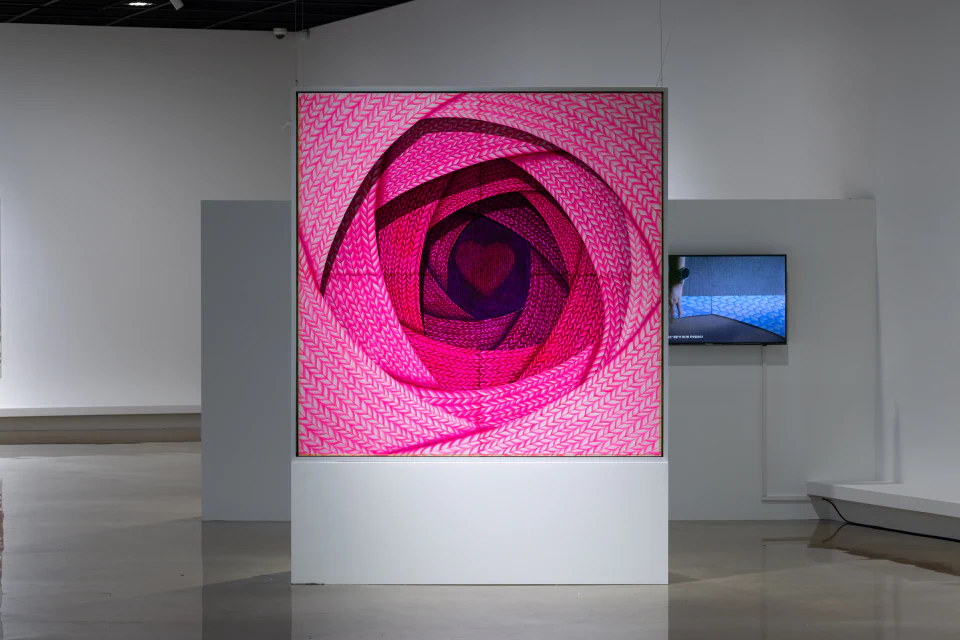
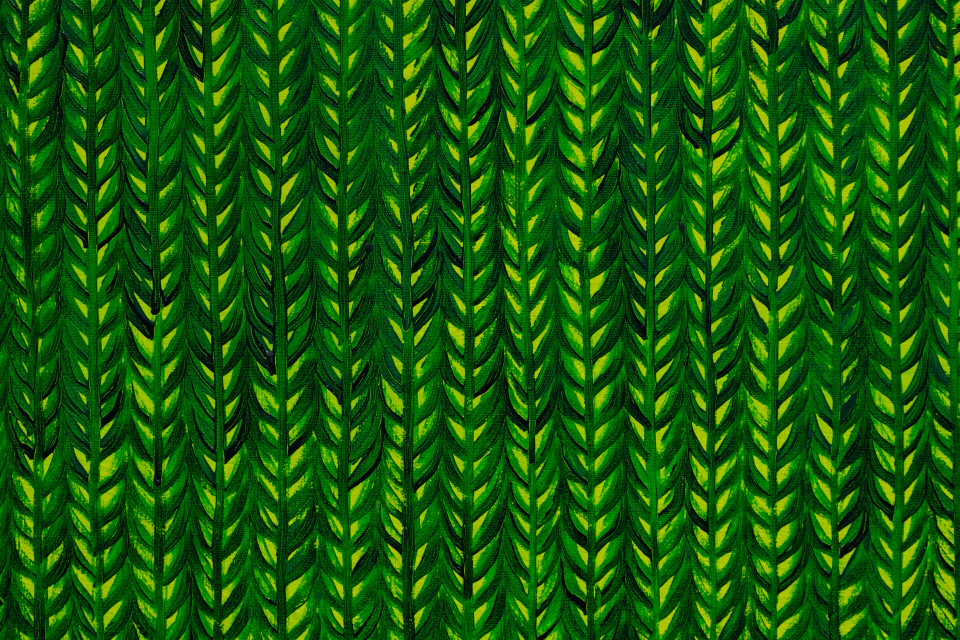
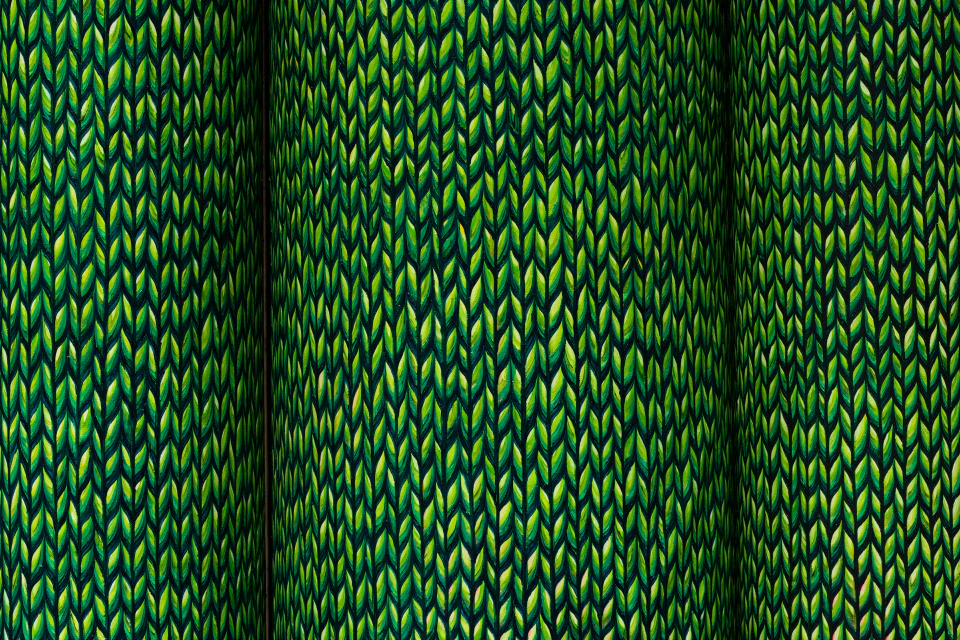
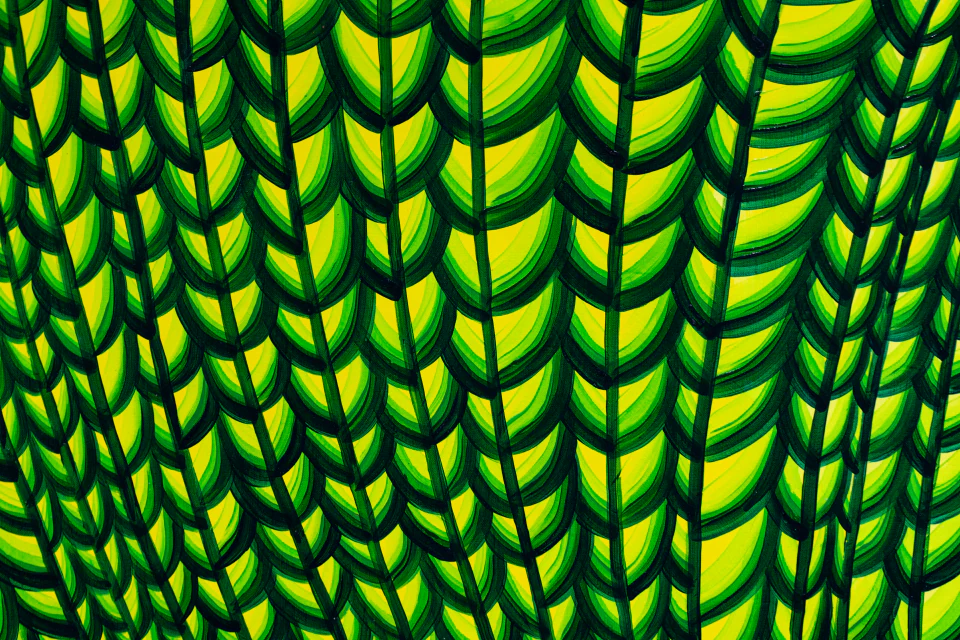
한 올 한 올 연결되는 듯한 표면은 손의 리듬과 시간의 축적을 드러낸다. 어느 붓질도 완전히 같지 않으며, 미세한 차이는 화면에 생명과 호흡을 만든다. 세부는 전체를 이루는 최소 단위이자 돌봄과 관계, 사랑의 에너지가 응축된 조형적 언어다.

SELECTED CAREER
“Knitting is Love.”
사랑은 관계를 잇고 생을 지속시키는 긍정의 에너지다.CRITICAL TEXTS
평론과 큐레토리얼 텍스트는 물감으로 뜨개실의 환영을 만드는 독자성, 기억과 노동을 품은 손의 의미, 실제 공간으로 확장되는 회화를 서로 다른 관점에서 조명한다. 이 글들은 한 개인의 기억이 시간과 관계, 회화의 조건에 대한 폭넓은 탐구로 발전하는 과정을 보여준다.
미술평론가 · 「뜨개질 그림」
박영택은 실제 뜨개질처럼 보이는 화면이 실이 아니라 물감과 붓질로 만들어졌다는 착시와, 전통적인 여성 수공예의 감각이 유화의 언어와 만나는 지점을 주목한다. 그는 정우경의 화면에서 추상과 구상, 붓질과 이미지가 동시에 공존하며, 독특한 기법을 넘어 회화 자체를 개념적으로 다루는 힘이 있다고 평가했다.
미술평론가 · 「대지의 숨결에 기대어」
황찬연은 화면에 켜켜이 쌓이는 붓질을 대지의 숨결과 호흡을 맞추는 행위로 읽는다. 작품의 표면에는 작가가 살아온 외적·내적 시간의 흔적이 함께 자리하며, 반복되는 결은 세계의 서로 얽혀 있음을 드러낸다. 그는 이러한 조형 어법이 재현과 비재현의 경계를 넘나들며 공간을 확장하고 응축시키는 회화적 운동성을 만든다고 해석한다.
대전시립미술관 학예연구사 · 「시간을 엮는 손: 정우경의 회화」
홍라담은 정우경 작업의 핵심을 ‘손’에 두고, 반복적 붓질이 시간성과 촉각성을 조직하는 장치로 작동한다고 본다. 뜨개는 개인적 기억을 넘어 시간을 물질로 응축하고 감정의 밀도를 직조하는 조형 원리로 확장되며, 최근 작업에서는 그 리듬이 캔버스의 경계를 넘어 공간을 점유하고 관람자의 몸까지 감각적 사건 안으로 끌어들인다고 평가한다.
PORTFOLIO · 2026
대표작과 작업의 전개, 주요 전시와 비평을 하나의 영문 포트폴리오로 구성했습니다. 뜨개에 대한 기억에서 대형 회화와 확장 캔버스에 이르는 흐름을 따라가며, 정우경의 연결의 언어가 시간과 공간 속에서 어떻게 전개되는지 보여줍니다.
CONTACT
갤러리, 미술관, 큐레이터 및 프로젝트 협업 문의를 환영합니다. 화실에서는 화면의 섬세한 결부터 입체적 구조까지 작품을 가까이에서 살펴볼 수 있으며, 방문은 사전 예약제로 운영됩니다.
그림은 표면에서 이루어진다. 그러니 회화를 회화이게 하는 것은 주어진 납작한 표면이다. 그것을 평면성이라 부르든 혹은 피부라고 부르든 별 상관은 없어 보인다. 결국 그림을 그린다는 것은 주어진 표면에 대한 해석이고 그 표면을 어떤 방식으로 점유해 들어가느냐, 또는 물감이나 붓질을 어떤 방식으로 보여주느냐 하는 문제이기도 할 것이다. 물론 그림은 그것만으로 충족되는 것은 아니다. 모더니즘회화(Modernist painting)가 평면성에 대한 강박으로 귀결되어 종내는 그저 물질, 사물 자체가 되어버릴 수밖에 없었던 것을 상기해본다면 그림은 물질이기도 하고 표면이기도 하지만 그 표면, 물질이란 즉물적 차원에만 저당 잡히지 말고 좀 더 다양하게 해석되고 개별적으로 환생하며 여전히 미완의 영역으로 남아 그 무엇인가가 활달하게 전개될 수 있는 영역이어야 할 것이다. 그래야 그림도 가능하고 화가들도 뭔가 작업할 명분이 생길 수 있는 것은 아닐까?
정우경의 그림은 희한하고 재미있다. 나는 실제 뜨개질로 이루어진 줄 알았지만 사실 그것은 캔버스에 물감과 붓질로 이루어진 ‘그림’이었다. 색상을 머금은 실이 길쭉한 대나무 바늘에 의해 촘촘히 직조되는 광경이지만 그것은 정성껏 그려놓은 붓질이다. 그 붓질, 물감은 보는 이의 눈을 속이고 실제 실인 것처럼 위장한다. 캔버스도 알고 보면 날줄과 씨줄로 직조된 화면이다. 그것은 일종의 텍스트다. 그 캔버스 천의 실을 다시 풀어서 뜨개질을 할 수도 있다. (실제 그런 작품도 존재한다) 반면 정우경은 실로 짜인 캔버스 표면 위에 다시 실을 그리고 그 실들이 직조되면서 모종의 이미지를 만들어가는 상황을 보여준다. 손은 부재하지만 바늘을 움직여 뜨개질을 하고 있고 그에 따라 무겁게 드리워진 실들이 사람의 얼굴이나 풍경을 만들어 보인다. 마치 유령이 뜨개질을 하는 듯하다. 보이지 않는 힘이 화면에 개입해 실을 늘어뜨리고 잡아당기는 것이다. 나로서는 각 나라의 화폐를 화면 상단에 정교하게 재현한 후에 그 아래로 각 화폐에 자리하고 있는 특정 인물을 뜨개질로 묘사하고 있는 작업이 재미있고 좋았다.
정교하게 그려진 미국의 1달러 지폐 표면이 상단에 자리하고 있고 그 아래에는 단색의 화면을 배경으로 해서 워싱턴 혹은 워싱턴과 오바마 대통령의 얼굴이 합성된 상태에서 그려지거나(상단의 지폐를 유심히 보면 작은 총알구멍이 그려졌다. 이는 미국 사회에서 빈번하게 발생하는 총기사고를 은유한다) 일본의 1만 엔권 지폐에는 후쿠자와 유키치(어두운 배경에는 희미하게 욱일승천기가 드러난다)와 아베 총리의 얼굴이, 중국의 위안화에는 당연히 모택동의 초상이 그려졌다. 한국 지폐의 경우는 1만 원권에 자리한 세종대왕(그 주변으로 한글이 꽃잎처럼 부유한다)과 5만 원 권의 신사임당(먹물이 튕긴 흔적을 통해 그녀가 뛰어난 서화가임을 암시한다) 등이 그려졌다.
각 나라의 화폐와 그 화폐를 장식하는 특정 인물의 얼굴을 흡사 뜨개질처럼 보이는 야릇한 붓질, 기법으로 그렸다는 것도 무척 재미있었지만 각국의 화폐와 화폐를 장식하는 인물, 그 나라와 인물에 얽힌 이야기를 은연중 읽어나가게 하는 장치가 흥미로웠다. 마치 숨은그림찾기를 하듯 화면 곳곳을 유심히 들여다보면서 작가의 풍자와 유머, 상상력을 접할 수 있다. 작가의 그림은 그렇게 두 가지 차원에서 묘미를 안긴다.
우선 붓질의 독특함이다. 이 붓질은 바탕화면에 정확한 간격을 재단한 후에 그 칸과 칸을 엇갈린 방향으로 칠해나가면서 뜨개질한 느낌을 가시화한다. 아니, 마치 실제 뜨개질을 한 것처럼 붓질을 하나씩 올려서 완성해간다. ‘정성’어린 그림이고 집요한 그리기다. 한 코 한 코 떠나가면서 두툼한 스웨터나 목도리를 짜주시던 어린 시절 엄마와 이모의 손길을 떠올리게 하는 그림이다. 전통적인 여성의 수공예 솜씨, 이른바 규방 문화적인 요소가 유화 기법과 조우하면서 하나의 풍경을 이루고 있는 게 신기해 보였다. 그것으로 인해 화면은 시각(착시를 유인해내는 화면)뿐만 아니라 일정한 볼륨을 지닌 실의 질감과 그것으로 인해 연상되는 여러 감각(촉각과 따스한 온기 등)을 풍성하게 자극하고 있다. 그림은 붓질 하나하나를 섬세하게 보여준다. 일정한 방향으로 칠해진 그 선/색은 추상적인 붓질이지만 그것들이 모여서 이미지를 안겨준다. 추상과 구상, 붓질과 이미지가 공존한다.
각국의 화폐는 단지 추상적인 기호에 머물지 않는다. 그것은 자국의 문화, 정치, 이데올로기 등을 방증하는 수단이기도 하다. 그래서 주로 자국의 정체성을 상징하는 역사적 인물이 등장한다. 영국의 엘리자베스 여왕, 미국의 초대 대통령 워싱턴, 일본 근대화의 아버지 후쿠자와 유키치, 중국 공산혁명의 상징인 모택동 등이 그렇다. 한국 지폐의 경우는 조선시대 성리학적 가치를 지향하는 인물들로 채워져 있다. 지폐는 단지 돈의 가치가 아니라 그 나라의 삶의 가치, 문화와 이념의 가치가 들어있어야 한다. 정우경은 그 지폐를 차용해 특유의 뜨개질 기법으로 그려 나가되 그 지폐가 함유하는 여러 맥락을 알레고리화해서 드러낸다. 그 전략이 소박하지만 무척 흥미롭다. 단지 독특한 기법에 머물지 않고 회화 자체를 개념적으로 다루는 한편 그림을 보고 알아가는 즐거움을 안기면서 보는 이의 시선과 마음을 은연중 흡입해 내는 묘미가 있다.
Painting takes place on a surface. What makes painting painting, then, is the flat surface that is given to it. Whether we call this flatness or skin is perhaps of little consequence. To paint is, in the end, to interpret that surface: to decide how it will be occupied and how paint and brushwork will be made visible upon it. Yet painting cannot be exhausted by surface alone. If we recall how Modernist painting’s fixation on flatness ultimately risked reducing painting to mere material or objecthood, then painting must remain more than matter and surface in an immediate, literal sense. It must continue to invite multiple interpretations, to be reborn through individual practices, and to remain an unfinished field in which something vital can still unfold. Only then, perhaps, does painting remain possible—and painters retain a reason to keep working.
Jeong Wookyung’s paintings are curious and compelling. At first I mistook them for actual knitting, only to discover that what I was looking at was, in fact, a “painting” made with pigment and brushwork on canvas. The image appears to show colored yarn being densely knitted with long bamboo needles, yet every strand is painstakingly painted. The brushwork and pigment deceive the eye, disguising themselves as real thread. Canvas itself, of course, is already a woven field of warp and weft—a kind of text, or textile, whose threads could in principle be unraveled and knitted anew. Jeong, by contrast, paints thread upon this already woven surface and stages the process by which those painted strands seem to interlace and form images. The hands are absent, yet the needles appear to move; weighted strands hang down and gather into faces or landscapes. It is almost as though a ghost were knitting, an invisible force entering the picture plane to stretch and pull the threads. I was particularly drawn to the works in which Jeong meticulously reproduces banknotes at the top of the canvas and then renders, in her knitting-like manner, the figures who appear on those currencies.
At the top of one work sits the finely rendered surface of a U.S. one-dollar bill; below it, against a monochrome ground, Washington appears alone or in a composite image with President Obama. A close look at the bill reveals small bullet holes, an allusion to the recurring problem of gun violence in American society. On the Japanese 10,000-yen note, Fukuzawa Yukichi appears alongside Prime Minister Abe, while a faint Rising Sun motif emerges from the dark background. The Chinese yuan bears, as expected, the portrait of Mao Zedong. In the Korean works, King Sejong appears from the 10,000-won note, surrounded by Hangul characters drifting like flower petals, while Shin Saimdang from the 50,000-won note is accompanied by splashed ink, a reference to her accomplishments as a painter and calligrapher.
The fact that Jeong renders currencies and the historical figures printed on them through this uncanny, knitting-like brushwork is in itself engaging. More intriguing still is the way the paintings prompt us to read the stories embedded in those currencies, their nations, and the people they commemorate. Looking closely across the surface becomes something like a game of hidden pictures, through which the artist’s satire, humor, and imagination gradually emerge. Her paintings thus offer pleasure on two intertwined levels.
The first lies in the singularity of the brushwork. Jeong begins by measuring the surface into precise intervals, then paints each section in alternating directions so that the accumulation of strokes evokes the structure of knitting. More than an evocation, it is as though the painting itself were knitted stroke by stroke. The result is an image made with extraordinary care and sustained, almost obsessive persistence. It recalls the hands of mothers and aunts from childhood, knitting thick sweaters and scarves one stitch at a time. Here, the traditions of women’s domestic handcraft—what might be associated with Korea’s gyubang culture—encounter the techniques of oil painting and form an unexpected pictorial field. The surface activates not only vision, through its trompe-l’oeil effect, but also the imagined volume and texture of yarn and the sensations it evokes: tactility, softness, warmth. Each brushstroke remains delicately legible. The individual lines and colors are abstract marks, yet together they produce recognizable images. Abstraction and figuration, brushstroke and image, coexist.
Currency, meanwhile, is never merely an abstract sign. It also testifies to a nation’s culture, politics, and ideology, which is why banknotes so often feature historical figures who embody national identity: Queen Elizabeth II in Britain, George Washington in the United States, Fukuzawa Yukichi as a figure of Japanese modernization, Mao Zedong as an emblem of the Chinese Communist Revolution. Korean banknotes likewise present figures associated with the Neo-Confucian values of the Joseon period. Money carries not only monetary value but also cultural, ideological, and social values. Jeong appropriates these currencies and re-paints them through her distinctive knitting-like technique, while allegorizing the multiple contexts they contain. The strategy is understated yet remarkably engaging. Her work does not stop at an unusual technique; it addresses painting itself conceptually, while giving viewers the pleasure of looking, discovering, and understanding—quietly drawing both eye and mind into the work.
대지는 인간 생명의 근원이자 종착지이며, 천변만화하는 대우주의 변화의 한 마당이다. 인간의 의지를 벗어난 지점에서 특별한 목적성도 없이 오로지 무한하게 펼쳐지고 다시 회귀를 반복할 뿐이다. 무한히 반복하는 대지의 운동들은 인간을 포함한 삼라만상의 복잡성과 다양성을 발생시키며 우리를 늘 기대할 수도 없고, 예상할 수도 없는 뭇 세계로 안내한다. 이러한 큰 마당의 품 안에서 인간은 대지의 숨결에 기대어 서로 배우고, 서로 숨 쉬고, 서로 나누며 살아간다. 그러나 이 대지가 순행하는 그 심오한 길은 인간의 이성과 오감으로는 명명할 수 없고 오로지 우리네 삶에 대한 깊은 통찰과 실천적 행위를 통해서 만이 도달할 수 있을 뿐이다.
작가 정우경은 대지의 숨결에 기대어, 대지의 부름에 응답하며 예술적 사유를 펼치고 접기를 반복한다. 커다란 붓을 들고 광활한 대지 위를 스치는 바람과 함께 춤을 추거나, 깊은 침잠 속에서 가녀린 세필로 대지의 숨결과 호흡을 맞추며 한 올 한 올 그 숨결들을 채우고 비워낸다. 대지의 결을 채우고 다시 지우는 행위는 세계-내-존재들의 서로 얽혀-있음을 드러내고 세계의 무목적성과 자신의 외부 세계와 내부 세계의 긴밀한 관계들을 은유적으로 표현하고 있다. 작가의 뜨개질 화풍의 작품이 우리에게 무엇인가를 환기하는 것, 화면에 켜켜이 쌓이면서 드러나는 미묘한 심미적 형상들 속에서는 누군가를 위해 기도하는 사람의 체온이 느껴진다.
작품의 표면에는 그가 세상과 함께 보내온 모든 외적 시간의 흔적이 고스란히 담겨있고, 그 심연에는 그가 자라오며 겪었던 내적 시간의 흔적들이 가감 없이 자리한다. 한 인간의 마음 씀은 어느 형상으로 옮겨지고, 그것은 그의 몸이 되고, 대지이자 대지의 숨결이 되어 보는 사람들의 정서로 스며들어 이내 하나로 어우러지며 깊은 공명을 일으킨다.
정우경의 <Past, Present and...> 시리즈 중 세로 130센티미터에 가로 900센티미터를 넘는 대작들이 몇 점이 있다. 일견 수행자의 용맹정진처럼, 고난의 성지순례자처럼, 어머니의 정화수 기도처럼, 자식에게 입힐 옷을 손수 짓는 어미의 마음처럼 일 년여 기간을 자기 몸을 붓 삼아 정성을 다해 탄생시킨다. 2~3년에 한 번 정도 이 대작을 완성하고 있는데, 작가로서 깊은 성찰의 시간을 갖는 것 같고, 명상의 공간에 자리한 수행자의 면벽수행을 연상시킨다.
작품의 제작과정을 요약하여 설명하자면, 그는 화실의 한쪽 긴 벽을 하얀 캔버스로 가득 채우고, 하얀 캔버스 위에 대지에 잠겨져 있는 온갖 생명들의 기운과 리듬을 표현한다. 그리고 왼쪽 끝부분에서부터 얇은 수직선을 내리그은 후 수직선을 중심으로 좌우로 붓질을 내려긋는다. 작은 이파리 같은 선들이 표면 위에 그어진다. 그 선 위에 다시 선이 올려지고 또다시 한 선이 쌓인다. 한 수직선 위에 수천 번의 선들이 쌓인 후에야 한 선이 마감된다. 그리곤 다시 한 선이 그어진다. 무한히 반복되는 수직선과 그 위를 가로지른 점들, 선들. 마치 뜨개질의 한 올 한 올이 서로 얽혀들며 한 땀 한 땀 생장하듯, 베틀 위에 펼쳐진 씨실과 날실이 무한히 교차하며 한 줄 한 줄 증식하듯, 하루, 이틀, 삼일, 한 달 두 달, 반년, 결국 한 해가 되어서야 그 광활한 대지 위에 마지막 결점을 찍는다.
작가의 이 작품은 완성된 후 전시장에서는 180° 회전되어 전시된다. 왼쪽과 오른쪽이, 하늘과 땅이 그 자리를 대체하는 것이다. 하여 아래로 내리그은 선들은 이제 하늘을 향해 일어서게 된다. 이러한 특성 때문일까? 가까이에서 관찰하며 보았던 모든 점, 선, 면들이, 한 줄 한 줄 엮어져 뜨개질로 만들어진 물질 같은 캔버스가 일제히 사라지고 오로지 눈앞에 푸르른 대지의 일렁임만이 느껴진다. 바람의 흐름을 따라 대지의 숨결을 따라 드러눕는 풀들의 아우성들이 일제히 터져 나온다. 캔버스 공간을 세분하여 나누고 반복적으로 자신의 붓질을 채워 넣음으로써 캔버스라 하는, 예의 작품이라 하는 가시적 공간을 비가시적 공간으로 전환한 것이다. 그리하여 대담한 상상적이고 유희적인 공간이 펼쳐지는 것이다.
작가 정우경과의 인터뷰에서 니체의 사유에 큰 감명을 받고 있으며, “대지의 부름”에 응답하고 있는 점에서 현재 자신의 예술적 사유와 궤를 같이하고 있다고 설명했다. 그리고 “세계의 모든 에너지의 근원을 어머니의 자궁과도 같은 긍정적이고 무한한 사랑임”을 강조했다. 니체는 그의 저서 <차라투스트라는 이렇게 말했다>에서 “대지의 부름”을 중심 개념으로 삼고 인간의 정체성, 의미 있는 삶, 도덕 등에 대한 니체의 사유 세계를 펼쳐낸다. 주요 요지는 인간이 스스로 발견하고, 자기 자신의 가치와 가능성을 인정하며, 다른 사람들의 가치나 편견에 휘둘리지 않고 자유롭게 살아가야 함을 강조하고 있다. 아울러 니체는 대지의 부름을 통해 현존하는 가치관을 뛰어넘는 새로운 도덕적 체계를 제시하며, 자기를 찾고 자유로운 영혼으로 살아가는 개인의 중요성을 강조한다. 이것은 곧 개인의 삶을 이끌어가는 창조적인 힘의 원천이며, 곧 자신이 삶의 주인이 되는 길이며, 곧 초월적 의지를 지닌 한 개인으로 성장하는 것이다. 이러한 니체의 사유는 다시금 질 들뢰즈의 “내재성의 사유”로 이어지는데, 질 들뢰즈는 니체의 사유에서 현대 철학의 새로운 사유의 지점을 찾아내었고, 니체가 강조하였던 자기중심성과 독립성, 자기 발전과 창조성은 들뢰즈의 “내재성의 사유”로 수렴되고 있다. 니체로부터 들뢰즈로 이어지는 사유는 대상과 주체 간의 이분법적인 구분을 해소하려는 시도이며, 타자와의 관계성 속에서, 대상과 주체의 상호작용성이란 작은 범주의 관계성을 벗어나 타자와의 상호작용과 관계에서 파생되는 모든 창조성을, 모든 아이디어를, 모든 개념, 모든 가능성, 모든 잠재성 등을 탐구하고 사유함을 내포한다. 더 나아가 타자의 존재성을 존중하고 타자의 사유를 인정하며 새로운 것을 창출하려는 사유의 확장을 강조한다. 이러한 맥락에서 작가의 작품세계의 주요 테제는 “긍정적이며 무한한 사랑”이라 할 것이고, 어머니와의 관계, 그리고 그 속 얽혀 있는 사랑과 이해가 실 뜨개질-뜨개 무늬로 등장하는 것이다. 그리고 니체의 “대지의 부름”은 결국 어머니의 대지이고, 모든 생명을 낳고 기르며 품고 있는 대지와 연결되는 것이다.
작가 정우경의 개인적 경험과 작품을 이끌어가는 그 예술적 사유를 생각해보면서 더불어 작가의 <Past, Present and...> 시리즈를 함께 관찰해봄으로써 작품 한 점 한 점에 대한 이해의 태도가 좀 더 깊어져 간다. 그의 작품에는 대상-세계의 관조적 태도와 이해의 태도가 중심을 이루고 있다. 자신의 개인적 경험과 그 안에서 발현된 정서와 정감 그리고 새로운 경험과 이해로의 확장은 작은 붓질로 시작되는 화면, 대지에 싹을 틔우는 생명의 몸짓들, 대지에 깊숙이 뿌리를 박고 하늘을 향해 느림의 성장을 거듭하는 모든 생명의 리듬을 포함하고 있다. 마치 뜨개질을 통해 실이 엮이며 무한히 생장하듯, 작가의 다양한 예술적 사유들이 서로 뒤틀리고, 비벼지고, 엮어지면서 다시 하나의 사유의 지평으로 흡수되는 것과 같다. 이렇게 반복을 거듭하며 생성된 작품의 결은 마치 우리 인간들의 복잡한 내면세계를 보여주는 듯 각양각색의 결들로 구조화된다.
이러한 결과물들이 그의 <과거 현재 그리고...> 시리즈로 귀결되고 있는데, 딸과 어머니가 함께 서로 합장하며 인사를 나누는 작품, 함박꽃웃음을 짓고 있는 어머니와 아들의 초상 작품, 생명을 잉태한 임산부의 초상 작품, 꽃으로 피어난 가족사진 같은 작품을 비롯해 모든 인류에게 자비와 헌신, 사랑과 용서의 아이콘인 마더 테레사, 마하트마 간디의 초상 등 그의 지난 수많은 작품에서 드러내고자 한 표현 의지들이 한 올 한 올 얽혀지며 넓고 깊은 예술적 사유의 마당을 구축하고 있다.
결론적으로 작가의 조형 어법은 대상을 표현하려는 재현적 방식을 벗어나서, 뜨개질-이미지를 통해 은유적이며 사유적인 회화적 표면의 구축이다. 사람의 마음을 따라 읽어가듯, 마음의 결들, 감정의 결들을 쫓으며 지나온 시간의 더께들을 걷어낸다. 이러한 행위로 인해 마치 실 뜨개질로 엮어낸 캔버스 같은 사물적 인상을 주고 있지만 작품의 표면에 가득한 인위적 표현을 비워냄으로써 오롯이 행위만을 남기는 태도가 드러난다. 아울러 뜨개질 구조이면서도 동시에 어떠한 대상-사물들을 유추할 수 있는 형상의 내면과 외면을 동시에 나타내어 보이는 작가의 조형 어법은 회화의 표면적 특성, 다시 말해 형상 중심적인 방식을 벗어나 작가적 신체-몸의 화면으로의 내밀한 투사, 색채와 색채들의 긴밀한 대비 그리고 일정한 간격들 사이사이의 미묘한 붓질의 움직임이 융합하면서 최종적으로 화면의 극렬한 운동성으로 나타나는 특성을 가진다. 이러한 비-형상적 특성이 강조되며 붓질이, 흐름이, 주름들이 내부와 외부의 경계에 위치하고, 공간을 확장 시키거나 응축시키며 회화의 경계를 넘나든다. 다시 말해 대상의 재현과 비-재현의 경계를 흐르며 허(虛)와 실(實)의 가변적 경계 사이에서 작품이 생성되는 것이다.
아울러 작가의 작품을 통해 우리 자신을 둘러싼 모든 세계에 보이지 않는 따듯한 마음 씀이 느껴진다. 오직 인간만이 지난 과거와 그 안에 스며들어 있는 깊은 분노와 슬픔 그리고 이것들로 인한 분별심에 사로잡혀 배려와 관용, 베풂과 자비, 용서와 이해의 너른 마음 씀을 잊어버리고 살아간다. 작가는 작품을 통해 이렇게 말한다. “기억하라! 너 자신은 누군가의 사랑과 헌신으로 인해 여기 이 자리에 있을 수 있음을.” 이 분주한 마음을 내려놓는 방법을 작가는 대지의 부름과 대지의 숨결을 따라서, 복잡성과 다양성으로 무한하게 얽혀 있는 세계의 구조를 드러내기 위해 자기의 몸을 대바늘 삼고 자신의 사유를 실 삼아 온몸으로 한 올 한 올 엮어내는 실천적 행위를 통해 우리에게 커다란 울림을 일으키고 있다.
The earth is both the origin and the final destination of human life, a vast field in which the ceaseless transformations of the cosmos unfold. Beyond the reach of human intention, it opens out without fixed purpose, endlessly repeating cycles of emergence and return. These recurring movements of the earth generate the complexity and diversity of all things, including human life, leading us toward worlds that cannot be fully anticipated or predicted. Within the embrace of this immense field, we live by leaning on the earth’s breath: learning from one another, breathing together, and sharing what sustains us. Yet the profound course by which the earth moves cannot be named through reason or the five senses alone. It can only be approached through deep reflection on life and through acts of lived practice.
Jeong Wookyung leans into the breath of the earth and responds to its call, repeatedly unfolding and folding her artistic thought. At times she seems to dance with the wind that sweeps across a vast terrain, wielding a broad brush; at others, immersed in deep concentration, she uses a fine brush to attune her breathing to that of the earth, filling and emptying the surface strand by strand. The act of inscribing and erasing the grain of the earth reveals how beings-in-the-world are entangled with one another, while metaphorically articulating both the world’s absence of predetermined purpose and the intimate relation between Jeong’s inner and outer worlds. In the subtle forms that accumulate across her knitting-like painted surfaces, one senses the bodily warmth of someone praying for another.
The surface of the work bears the traces of all the external time the artist has lived in the world, while beneath it remain the unfiltered traces of the internal time she has accumulated through experience. A gesture of care passes into form; form becomes body, earth, and the breath of the earth. It then enters the viewer’s emotional register, where these elements converge and generate a deep resonance.
Within Jeong’s Past, Present and… series are several monumental works measuring more than 130 centimeters in height and over nine meters in width. Each takes roughly a year of concentrated labor to bring into being. Their making recalls the fierce discipline of spiritual practice, the endurance of a pilgrim, a mother’s prayer before a bowl of pure water, or the devotion of a parent making clothing by hand for a child. Jeong completes such monumental works only once every two or three years. The duration of their production suggests a sustained period of introspection, akin to a practitioner seated before a wall in silent meditation.
Her working process may be described as follows. Jeong first covers one long wall of her studio with white canvas, upon which she seeks to evoke the energy and rhythms of myriad forms of life latent within the earth. Beginning at the far left, she draws a slender vertical line and then lays brushstrokes to either side of it. Small, leaf-like marks gather on the surface; one line is laid over another, then another again. Thousands of strokes accumulate around a single vertical axis before that section is complete, after which the process begins anew. Vertical lines repeat seemingly without end, crossed by innumerable points and marks. Like loops of knitting interlocking stitch by stitch, or warp and weft multiplying through the repeated crossings of a loom, the work grows over days, weeks, months, half a year, and finally a year, until the artist places the last mark upon this expansive field of earth.
Once completed, the work is rotated 180 degrees for exhibition. Left and right, sky and ground, exchange their positions, and the lines that were initially drawn downward now rise toward the sky. Perhaps because of this reversal, the dots, lines, and planes that had been visible at close range—and the material impression of a canvas seemingly knitted line by line—suddenly recede. What remains before the eye is the undulation of a verdant earth. Grasses appear to bend and cry out in unison, carried by the current of the wind and the breath of the land. By subdividing the canvas and filling each interval through repeated brushwork, Jeong transforms the visible space of the canvas—the conventional space we call an artwork—into an invisible, experiential space. A bold, imaginative, and playful field thereby unfolds.
In conversation, Jeong has spoken of the profound impact of Nietzsche’s thought and of how her own artistic thinking resonates with what she understands as the “call of the earth.” She has also emphasized that “the source of all energy in the world is a positive and infinite love, like a mother’s womb.” In Thus Spoke Zarathustra, Nietzsche’s insistence on remaining faithful to the earth opens onto questions of human identity, meaningful life, and morality. His thought asks the individual to discover and affirm one’s own value and potential, rather than living according to inherited judgments or the prejudices of others. It proposes the possibility of creating values beyond existing moral systems and stresses the importance of becoming a free spirit who assumes responsibility for one’s own life. This creative force becomes a source through which one can become the author of one’s life and grow into a self-determining individual. Nietzsche’s thought, in turn, leads toward Gilles Deleuze’s philosophy of immanence, which seeks to move beyond rigid divisions between subject and object and to explore the creativity, concepts, possibilities, and potentials that arise through relations with others. It is a mode of thought that respects the existence and thinking of the other while opening toward the production of the new. In this context, the central proposition of Jeong’s practice may be understood as “positive and infinite love”: the love and understanding embedded in her relationship with her mother reappear through the structures and patterns of knitting. The “call of the earth,” in this sense, becomes inseparable from the maternal earth—the earth that gives birth to, nourishes, and embraces all life.
Considering Jeong’s personal experiences alongside the artistic thinking that guides her work deepens our encounter with each piece in the Past, Present and… series. At the core of her work is an attitude of contemplation and understanding toward the world of things. Personal memories, the emotions and affections that arise from them, and their expansion into new experience and understanding all enter the picture: the small brushstroke from which the surface begins, the gestures of life sprouting from the earth, and the rhythms of living things that root themselves deeply in the ground and grow slowly toward the sky. Just as yarn expands through the interlacing structure of knitting, Jeong’s varied lines of thought twist, rub against one another, and become entwined before being absorbed into a broader horizon of reflection. The textures generated through this repetition take on multiple structures, as complex and varied as the inner worlds of human beings.
These concerns converge in the Past, Present and… series. Across Jeong’s many works, a broad field of artistic thought has been woven strand by strand: a daughter and mother greeting one another with palms together; a smiling mother and son; a pregnant figure carrying new life; family portraits blossoming into flowers; and portraits of Mother Teresa and Mahatma Gandhi, figures associated with compassion, devotion, love, and forgiveness. The impulses expressed across these images are gradually interwoven into a wide and deep terrain of thought.
Ultimately, Jeong’s formal language moves beyond conventional representation toward the construction of a metaphorical and contemplative pictorial surface through the image and structure of knitting. As though reading the grain of a person’s mind, she follows the textures of feeling and peels back accumulated layers of time. Although this process gives the canvas the object-like appearance of a textile woven from yarn, the work simultaneously empties the surface of overtly artificial expression, leaving the act itself exposed. Her pictorial language operates as a knitted structure while also allowing the inner and outer dimensions of recognizable forms and objects to emerge. Moving beyond an image-centered conception of painting, the work becomes an intimate projection of the artist’s body onto the surface: close contrasts of color and subtle shifts of brushwork across measured intervals converge into an intense pictorial movement. In this non-figurative register, strokes, flows, and folds occupy the threshold between inside and outside, alternately expanding and compressing space and moving across the boundaries of painting. The work is thus generated in the shifting interval between representation and non-representation, between emptiness and presence.
Jeong’s work also conveys an invisible warmth directed toward the world around us. Human beings, caught in anger, grief, and the discriminations accumulated through the past, too easily forget the capacious virtues of consideration, tolerance, generosity, compassion, forgiveness, and understanding. Through her work, the artist seems to say: “Remember: you are here because of someone’s love and devotion.” Following the call and breath of the earth, Jeong reveals a world infinitely entangled in complexity and diversity through a sustained practice of making. Her body becomes the knitting needle and her thought the yarn; with her whole being, she weaves one strand at a time. It is through this embodied act that her work achieves its profound resonance.
회화는 종종 시각적 재현을 위한 정적인 매체로 이해된다. 그러나 정우경의 작업에서 회화는 시간과 감정, 물질이 충돌하며 새로운 운동성을 획득한다. 그는 대상을 고정된 형태로 묘사하기보다는 흐르는 시간과 스며드는 감정을 화면 위에 쌓아 간다. 〈과거, 현재 그리고 대지〉 연작에서 그의 붓질은 일정한 리듬을 따르지만 기계적 반복에 머물지 않는다. 선은 천천히 흐르고 기억은 무겁게 쌓인다. 그렇게 쌓인 시간들은 화면을 단순한 평면 너머로 이끌어 유기적인 움직임을 만들어낸다. 정우경은 그렇게 회화를 통해 지나간 시간과 아직 머물고 있는 감정 사이의 미묘한 간극을 끊임없이 드러낸다.
정우경 작업의 핵심은 ‘손’에 있다. 규칙적이면서도 유연한 손의 움직임은 단순한 기술을 넘어 시간성과 촉각성을 조직하는 장치로 기능한다. 뜨개질이라는 개인적 기억은 이 과정의 출발점이다. 어린 시절 어머니의 손길에서 체화된 반복과 돌봄의 리듬은 그에게 있어 회화적 언어의 근원이자 감각적 구조를 구축하는 토대가 된다. 뜨개는 단순한 소재를 넘어 정우경 회화의 조형적 원리로 작동한다. 그의 작업에서 뜨개는 시간을 물질로 응축하고 감정의 밀도를 직조하는 행위로 확장된다. 이는 루이즈 부르주아가 반복적 노동을 통해 기억과 감정을 시각화한 방식, 그리고 1970년대 페미니즘 미술에서 여성적 노동과 일상의 감각을 예술적 언어로 전유한 흐름과도 닿아 있다. 이러한 뜨개의 구조적 특성은 그의 회화에서 선과 색의 흐름으로 변주되고, 화면은 단일한 표면이 아니라 시간과 감정이 겹쳐지는 살아 있는 장으로 작동한다.
위의 감각은 자연스럽게 회화의 전통적 경계를 넘어서는 흐름으로 이어진다. 정우경의 작업은 화면을 단순히 구성하는 데 머무르지 않고 시간과 물질의 장으로 전환하는 데 초점을 맞춘다. 그는 화면을 변형하고 선과 색의 리듬을 다층적으로 중첩시키며 내부의 에너지를 외부로 확장하는 열린 구조를 구축한다. 이 과정에서 회화는 닫힌 평면이 아니라 감각과 인식이 흐르는 공간적 사건으로 변모한다. 〈과거, 현재 그리고 에너지〉 연작은 이러한 시도를 밀도 높게 보여준다. 정우경의 회화는 시각적 체험을 넘어 시간과 감정, 물질이 맞물리는 역동적 장을 열어간다. 결과적으로 그의 작업은 공간을 점유하고 관람자의 몸을 감각적 사건의 일부로 끌어들이며 회화의 전통적 범주를 넘어선다.
최근 작업에서는 평면적 구성의 한계를 적극적으로 넘어서는 움직임이 한층 두드러진다. 반복되는 붓질의 리듬은 더 이상 캔버스의 경계에 갇히지 않고 화면을 넘어 공간 속으로 확장된다. 회화는 시각적 대상에 머무르지 않고, 촉각적이며 입체적인 감각의 장으로 진화한다. 이는 회화적 경험을 단일한 시각의 차원에서 해방하려는 시도이며, 나아가 감각 전체를 깨우는 복합적 체험으로 확장하려는 의지를 드러낸다. 그의 작업은 회화를 바라보는 방식을 넘어, 회화를 감각하고 체험하는 방식 자체를 다시 질문하게 만든다.
《제22회 이동훈미술상 특별상 수상작가전》에서 정우경은 회화가 더 이상 시각적 재현의 수단에 머물지 않고, 시간과 감각을 구축하는 살아 있는 매체로 확장될 수 있음을 증명한다. 정우경은 외부 세계를 모사하거나 복제하는 방식에 관심을 두지 않는다. 그는 경험과 감정, 관계의 밀도를 천천히 축조하는 쪽을 택한다. 그의 작업은 형태를 규정짓기 이전의 흐름을 포착하고, 의미를 부여하기 이전의 원초적 리듬을 호출하려는 시도에 가깝다. 캔버스 위에서 반복되는 붓질은 단순한 흔적을 남기는 것이 아니라, 화면 전체를 긴장시키는 힘의 망을 형성한다. 그의 작업은 반복과 변주를 통해 감정과 시간의 밀도를 확장하며, 평면을 넘어서는 감각적 공간성으로 진화하고 있다. 정우경의 회화는 ‘보는 것’을 넘어, 시간을 만지고 감각을 거닐게 한다. 그것은 느린 손짓으로 짜인, 살아 있는 시간의 직조다.
Painting is often understood as a static medium for visual representation. However, in the work of Jeong Wookyung, painting becomes a site where time, emotion, and material collide, acquiring a new sense of movement. Rather than capturing fixed forms, Jeong layers flowing time and seeping emotions onto the canvas. In her series Past, Present, and the Earth, her brushstrokes follow a certain rhythm but never fall into mechanical repetition. Lines flow slowly; memories accumulate heavily. Through these layers, the surface transcends its flatness, unfolding into an organic movement. Jeong persistently reveals the subtle intervals between the time that has passed and the emotions that continue to linger.
At the core of Jeong’s practice lies the “hand.” Her methodical yet supple hand movements function not merely as a technical gesture but as a mechanism for organizing temporality and tactility. The act of knitting, a personal memory, forms the origin of her process. The rhythm of repetition and care, embodied from her mother’s touch in childhood, serves as both the root of her painterly language and the foundation for building a sensory structure. Knitting operates not merely as a motif but as a formative principle in Jeong’s paintings. In her work, knitting extends into an act that condenses time into material and weaves emotional density into tangible form. This resonates with Louise Bourgeois’ visualization of memory and emotion through repetitive labor, as well as the appropriation of domestic labor and sensory life into artistic language found in 1970s feminist art. The structural qualities of knitting are variably transposed into the flows of line and color across Jeong’s paintings, rendering the canvas a living field where time and emotion intertwine rather than a mere pictorial surface.
This sensibility naturally leads Jeong’s practice to surpass the traditional boundaries of painting. Her focus lies not in composing a surface, but in transforming it into a field of time and material. She deconstructs the conventional limits of the frame, layering rhythms of line and color to build an open structure where internal energies are propelled outward. In this process, painting no longer remains a closed plane but becomes a spatial event where sensation and perception stream and flow. Her Past, Present, and Energy series vividly manifests this endeavor. Jeong’s paintings open dynamic fields where time, emotion, and material intersect, moving beyond the realm of visual experience. Ultimately, her works occupy space, drawing the viewer’s body into the fabric of sensation, and transcending the traditional boundaries of painting.
In her recent works, Jeong’s attempts to overcome the limits of the pictorial plane have become even more pronounced. The rhythmic brushstrokes no longer remain confined within the borders of the canvas; they spill outward into the surrounding space. Her paintings evolve into tactile and spatial experiences, liberating painting from the narrow domain of visuality alone. This development reveals her intent to awaken the entirety of human senses, expanding painting into a complex, immersive encounter. Jeong’s work challenges not only the ways we view painting, but fundamentally how we experience and engage with it.
At the 22nd Lee Donghoon Art Award Special Exhibition, Jeong Wookyung demonstrates that painting need not be bound to visual representation but can evolve into a living medium that constructs time and sensation. She shows little interest in mimicking or replicating the external world. Instead, she meticulously builds layers of experience, emotion, and relational density. Her work seeks to capture the flow before form is defined and to summon the primordial rhythms before meaning is assigned. The repeated brushstrokes across her canvases do not merely leave traces; they weave networks of tension across the surface. Through repetition and variation, Jeong extends the density of emotion and time, pushing her paintings toward a sensorial spatiality beyond the flat plane. Her paintings invite viewers not merely to see but to touch time and wander through sensation. They are slow, living weaves of time, spun through tender, deliberate gestures.